
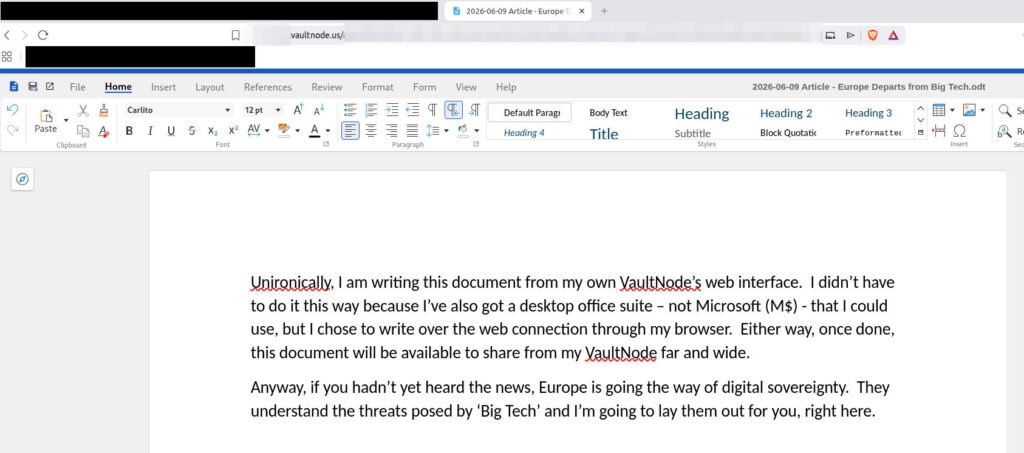
Unironically, I am writing this document from my own VaultNode’s web interface. I didn’t have to do it this way because I’ve also got a desktop office suite – not Microsoft (M$) – that I could use, but I chose to write over the web connection through my browser. Either way, once done, this document will be available to share from my VaultNode far and wide.
Anyway, if you hadn’t yet heard the news, Europe is going the way of digital sovereignty. They understand the threats posed by ‘Big Tech’. But there is one thing everyone seems to have missed, and I’m going to lay it out for you, right here.

European governments and private entities are speeding up their efforts to dismantle their reliance on US software and cloud infrastructure. They realize that tethering their national security and data sovereignty to corporations, especially foreign ones, is a strategic error that no longer serves their interests.
From the European Parliament switching their search engine away from Google to Qwant to the French government implementing its own open-source “LaSuite” office software, there is a clear trend toward digital independence. Cities in the Netherlands and Germany are dumping Microsoft and Google, while countries like Finland are keeping sensitive election data off Amazon’s cloud servers. The goal is simple: to build a digital environment that isn’t under the thumb of Washington or Silicon Valley.
However, like a date that doesn’t want to pay for the meal anymore and bolts for the exit, the economic reality for those left behind is foreboding. Big Tech firms view Europe as a critical revenue center, and they will not let these markets slip away quietly. As their user base and subscription revenue shrink abroad, these corporations will inevitably look to make up for those losses. Obviously, there will be related job cuts, even in the US, and ever-increasing replacement of human beings with AI. But as for you, the end user, it means they will push more aggressive data-mining tactics and invasive tracking on their remaining user base—primarily here in the US—to maximize the value of every remaining click and data point.
When a company loses a global client, it squeezes the domestic one. For the average user, this translates to more intrusive advertising, more sophisticated behavioral surveillance, and a tighter grip on personal data to feed the algorithms that drive their bottom line. The “free” services we have grown accustomed to are becoming increasingly expensive in terms of our own privacy and autonomy.
As Fabian Mehring Bavarian State Minister of Digital Affairs has stated, “We no longer have time to cheaply discuss the importance of digital sovereignty… we need to get from talking to doing.”
Here at Digital Colonies, we recognized long ago that the traditional tech stack is not just a service; it is a mechanism for global control. Our mission is to provide the infrastructure to replace this failing ecosystem entirely. By moving to private, independent, and secure alternatives, you aren’t just protecting your information—you are refusing to subsidize the intrusive business models that rely on exploiting the data of those who have not yet moved. The choice is between continuing to feed an increasingly desperate, extractive tech monopoly or building a truly sovereign foundation. If you live in the Tucson area and are ready to move away from big tech, click the button below to see how our flagship product works.